Wednesday, July 5, 2023

A forgotten piece of history with implications for today.


August 1, 1942 - the American Federation of Musicians began a strike against major American record companies because of disagreements over royalty payments. Beginning midnight, July 31, 1942, no union musician could make commercial recordings for any commercial record company. The strike was the longest in entertainment history (1942-44), had a major cultural impact but also left many problems unresolved to this day. #WGAstrong #sagaftramember #1u.

https://www.wnyc.org/story/524-the-day-the-music-stopped/

Saturday, May 6, 2023

The Asian American Roots of Chicago Aikikai and aikido in Chicago

 Here's a little something I wrote up for Asian American and Pacific Islander Heritage Month about Chicago Aikikai, the dojo where I practice the Japanese martial art of aikido. The original post may be found here.

“To practice Aikido fully, you must calm the spirit and go back to the origin.”

-Morihei Ueshiba, Founder of Aikido

Aikido, a martial way

May is Asian American and Pacific Islander Heritage Month, so it seems like a good time to turn back the clock and look at the Asian American origins of Chicago Aikikai and its place in bringing the Japanese martial art of aikido to the Windy City.

Martial arts are probably more ubiquitous than ever in U.S. pop culture, thanks to fighting-themed video games, superhero films and stunt heavy actioners like the John Wick series, and of course the multi-billion dollar industry that is Mixed Martial Arts (MMA). However, the success and widespread reach of these ventures has led most folks nowadays to associate the words “martial arts” solely with high-contact sports or violent maneuvers employed in imaginary street encounters.

Lost is the fact that, especially in the case of Japanese martial arts, there has long been a movement away from strictly studying practical fighting, and towards athletic and philosophical ends, not to mention spiritual and artistic (We’ll just skip their role in WWII militarism for now). Those whose only image of pre-industrial Japan is blood-soaked duels to the death informed by Rurouni Kenshin, the Zatoichi series and Akira Kurosawa period dramas might be surprised by the more than 200-year stretch of peace and stability known as the Edo period (1603-1868), during which most of the cultural touchstones considered characteristically “Japanese” in the West reached their pinnacle. Those would include flower arrangement, kabuki theater, ramen, sushi and budō (武道). Though usually translated as “martial arts”, budō  is more appropriately read as “martial way”, the dō being the same Chinese character for Taoism, as opposed to bujutsu (武術): “martial techniques” used in actual combat.

In that sense, it would be appropriate to regard aikidō (合気道) and other budō as an expression of Japanese culture; the “art” part deserving as much emphasis as the “martial”. And I think that is important to note in light of who first brought it to places in the U.S. like Chicago and helped it to thrive. For those early days of aikido were still a time when many Japanese Americans were not always welcome to participate in mainstream sports and other activities; or to openly engage in practices that allowed them to be Japanese.

Connections, personal and not

2023 will mark my 30th year training in aikido, most of which has been at Chicago Aikikai. I am also fourth-generation Japanese American (or yonsei) on my father’s side and spent my entire life as a resident of the Chicago area (born in River Forest, attending University of Chicago, and now living on the north side). However, despite this, and the fact that Chicago Aikikai began as a Japanese American organization, I have no legacy ties. I joined in 1995, after graduating from University of Chicago, where the head of the on-campus aikido club, the late Professor Donald Levine, introduced me. Prior to that, I started aikido while attending Waseda University in Tokyo on the Great Lakes Colleges Association/Associate Colleges of the Midwest one-year Japan Study program.

I’m not even part of the same group of Japanese Americans who started the dojo (Yes, we have subdivisions), my father having arrived in 1959 from Kauai to attend Illinois Institute of Technology. Yet its history is a point of fascination for me and does elicit that strange sort of pride one gets from something you might share an ethnic kindship with, even if there is no direct connection.

Sadly, that history is gradually being lost day-by-day, year-by-year, person-by-person. Like most of the long-standing Japanese American organizations in town - from the Buddhist Temples to the churches to the social service organizations – it feels like those earlier generations were primarily concerned with working and surviving (as they should have been). So no real organized attempt was made to preserve and archive memories with the passing of time. Coupled with that was the gradual transition of the dojo from a rather informal community-centric club to an officially accredited entity [black belt ranks come from Aikido World Headquarters in Tokyo, via its national umbrella organization Aikido Schools of Ueshiba (ASU)], which went hand-in-hand with the joining of non-Japanese. Today, I’m really the only person of Japanese descent regularly training there.

When I was in my 20s, there were still a few holdouts from the old days. Joe Takehara, a now-retired dentist noted for his ability to make his body feel as solid as concrete while maintaining a state of relaxation, and Yuki Hara, a grandmotherly figure who inexplicably seemed to attend every camp and seminar across the country. However, they’re both retired now, taking their stories with them.

I sometimes feel like Chicago Aikikai is akin to the Nisei Lounge, “Chicago’s finest dive bar”, located in Wrigleyville. Nisei Lounge (taking its name from the term for second-generation Japanese Americans) was founded in 1951 back when Clark Street was part of Chicago’s Unofficial Japan Town. The nisei aren’t around anymore, but the current owners have kept the name and mementos of the bar’s past. The bar is also occasionally a venue for Japanese American community events.

In any case, here is a very incomplete history of the early days of the Chicago Aikikai and its Japanese American roots cobbled together from anecdotes, late-night talks over drinks and a handful of interviews. Special shout-outs to Joe Takehara and Erik Matsunaga.

Dwight Sora

Chicago, 2023

NOTE 1: I have chosen to begin my timeline with key events in the development of aikido in Japan and Hawaii to provide historical context.

NOTE 2: Given the fragmentary nature of my sources, I welcome anyone with first-hand knowledge who reads this, spots inaccuracies and can offer corrections. If you have anything, please e-mail chiaikikai@gmail.com.

Early history of Chicago Aikikai (originally Illinois Aikido Club)

1920s -      Morihei Ueshiba creates aikido based on traditional Japanese martial arts.

1940    -      Aikido is officially recognized by the Japanese government.

1948    -      Aikikai Foundation and Aikido World Headquarters (Hombu Dojo) based in Tokyo, Japan is established.

1952    -      Hombu Dojo begins dispatching instructors overseas to spread aikido.

1953    -      At the invitation of the Nishikai Health Organization in Honolulu, Hawaii, Hombu Dojo sends instructor Koichi Tohei (1920-2011) to participate in a demonstration of Japanese martial arts. Impressed, many spectators take up training in aikido, first held on the grounds of the Nishikai. Tohei stays for one year, establishing many dojo in the islands, and making it a center for the art’s spread within the country. Tohei’s Hawaii students include instructors Isao Takahashi and his son Francis Takahashi. Tohei returns to Hawaii in 1955 and  1959 to further strengthen the aikido base he created.

1961    -      Norman Miyagi, a nisei (second generation Japanese American), becomes interested in aikido after reading a book by Koichi Tohei (most likely Aikido: The Arts of Self-Defense, 1957). Together with John Omori, they recruit other nisei by word-of-mouth and begin meeting privately to teach themselves aikido as a cultural pastime and for its mental and physical benefits. Rather than youthful dabblers, they are all established professionals in their 30s and older. In addition to Miyagi (an osteopathic physician) and Omori (an optometrist), the initial group includes Anthony Muranaka (a Chicago Police detective), Saburo Tanaka, Robert “Red” Sakamoto  and Joe Takehara (a dentist).

- The group begins meeting in the storefront basement of Muranaka’s three-flat at 3324 N. Clark Street in the north side Lake View neighborhood. At the time the area is known as Chicago’s unofficial Japantown, a community of Japanese Americans that formed after WWII including transplants from Hawaii but mostly former wartime camp internees originally from the West Coast. The floor is made of marble and only 12' x 15', and the group trains without a mat. Lighting comes from a single ceiling light bulb; when it breaks, class is over for the evening.

- Through their Hawaiian Japanese connections, the group eventually makes contact with Chester Sasaki, a second degree black belt from Hawaii who is an undergrad at University of Illinois in Champaign. Under direction from Tohei and Hombu Dojo, Sasaki becomes their first official chief instructor. He makes regular weekend trips (3 hours each way) to lead all-day Saturday and Sunday classes.

- The group leases a street-level storefront on the next block at 3223 North Clark Street. They construct their first mat using purchased two-inch etherfoam. The resulting surface is much admired and used as a model for mats at several other Chicago dojo.

- There is no sign. The only advertising continues to be word-of-mouth, and entry to membership is limited. There is a board which interviews prospective students to evaluate their character. Most prospects are allowed in, but only after watching a few classes.

- In November, the group files with the state of Illinois to incorporate as a non-profit.

1963    -      The group is officially incorporated as Illinois Aikido Club (IAC), thus establishing the Midwest’s first public aikido dojo. It adopts a circular logo symbolized by a circular mirror on a larger circular wood frame, forming part of the dojo’s shomen.

- Instructor Francis Takahashi (a childhood friend of Chester Sasaki from Hawaii) relocates to Chicago as a result of being inducted into the U.S. Army and is stationed here for two years. Sasaki is leaving the group due to graduating from University of Illinois and entering the Air Force, so Takahashi assumes the position of chief instructor.

1964    -      Koichi Tohei teaches two seminars at IAC as part of a one-year tour of U.S. dojo.

1965    -      Yoshihiko Hirata, a young sandan sent from Hombu Dojo, becomes the dojo’s third chief instructor and teaches until 1969, when he is inducted into the U.S. Army.

-      Instructor Isao Takahashi, Francis Takahahi’s father, comes to Chicago from Los Angeles to serve as chief instructor of IAC. Takahashi alternates between the two cities, teaching aikido and iaido in Chicago for two months, and then returning to Los Angeles for a month. In his absence, Saburo Tanaka and Robert “Red” Sakamoto lead class in his place.

- Cheryl Kajita (later Matrasko), future founder of Aikido of Skokie, begins training at IAC.

Late 60s/Early 70s          -             Jon Eley (future instructor of Chicago Ki Aikido) and Frank Knapp are among the first non-Japanese to join the dojo, beginning a shift in membership demographics away from a majority Japanese American group.

1970    -      IAC moves into a space in the Uptown neighborhood at 1103 W. Bryn Mawr. A former bowling alley that had been vacant for 20 years, it undergoes major renovation to create a dojo with a huge mat space - 45’ x 80’ feet.

1971    -      Takahashi decides to retire to California. Hombu Dojo is contacted and instructor Akira Tohei is recommended to serve as new chief instructor and travels to Chicago from his then-current base in Hawaii to teach a summer seminar and meet with IAC’s Board of Directors.

1972    -      Tohei relocates to Chicago to both serve as IAC chief instructor and establish the Midwest Aikido Federation (MAF). Isao Takahashi passes away on February 6 in Los Angeles at age 59 from stomach cancer.

- Charles Tseng (later founder of Lake County Aikikai) is invited to instruct at IAC by Akira Tohei.

1973    -      Kisshomaru Ueshiba, son of Morihei Ueshiba and second Doshu, visits Chicago for the first time and teaches a seminar at IAC.

1975    -      Tohei leaves IAC to form Midwest Aikido Center (MAC).

- Several guest instructors, including Terry Dobson and Robert Nadeau, teach at IAC on weekends.

- Mitsugi Saotome leaves his position as a senior instructor and Chief Weapons Instructor at Hombu Dojo and relocates to Sarasota, Florida in May at the invitation of local instructor Bill McIntyre. Saotome founds Sarasota Aikikai.

- That winter, Sarasota Aikikai hosts a 7-day camp starting on December 26 with instruction by Saotome and guest instructors Terry Dobson, Ed Baker and Frank Hreha. 85 aikidoka from around the country attend, 10 of which are members of IAC including Yuki Hara, Wendy Whited (later founder of Inaka Dojo) and Charles Tseng.

- Saotome establishes Aikido Schools of Ueshiba (ASU), an umbrella organization for dojo following his teachings.

1976    -      IAC becomes a member of Mitsugi Saotome’s organization ASU and Saotome sends his student Shigeru Suzuki to serve as chief instructor.

1981    -      Suzuki is forced to return to Japan due to health reasons. Kevin Choate is appointed the first non-Japanese chief instructor. He will hold this position until his death in 2012. He is succeeded by current chief instructor Marsha Turner.

Tuesday, April 18, 2023

Thoughts on Netflix's BEEF

Thoughts on Netflix's BEEF

  •         It’s well-made and deserving of praise, especially for exploring areas of the Asian American experience that have not been dramatized in highly-publicized mainstream works.
  •         Personally, I’d be disappointed if the controversy around David Choe brings it down.
  •         Even if Choe was just joking in bad taste, he’s an adult and should know better
  •         Choe, Steven Yeun and Ali Wong are established enough media figures in my opinion that they should have anticipated the situation and possible public response.
  •         Their reaction is clumsy and only amplifies the feeling Choe is guilty of something, and frankly, they are going to reap what they sowed.

Wednesday, April 5, 2023

30 Years of Aikido

2023 will mark my 30th year training in the martial art of aikido, something I started when studying abroad at Waseda University in Tokyo. Honestly, I never thought something I tried on a whim would become a life-long pursuit.

During 2020-21, as the pandemic shut down in-person classes, I had a lot of time to think about what aikido means to me. When Zoom classes were started, I had a chance to take instruction from a wide variety of teachers from around the country I don't normally get to see. And it gave me a new appreciation for all the different ways people look at the art, even the ones I might not have gravitated towards before. 

The resumption of in-person training didn't mean I could just jump back into things. Those two years had cut into my work quite a bit, so time and money needed balancing, not to mention work and family. When I do get to the dojo, I'm just happy to be there.

Years before all of this, I sketched out an aikido-themed picture based on the Eastern parable of the Blind Men and the Elephant. The "Aikido Elephant" or "Aikidō no zō" (合気道の象) is a playful image expressing the myriad dimensions of the Japanese martial art of aikidō (合気道), and the many approaches of its teachers and students. It is a reminder to all those studying aikidō that they are on a path of individual self-discovery; best taken with grace, humility and open-mindedness. The title is a play on words, as the Japanese word zō (象) meaning elephant is a homonym for zō (像) meaning meaning figure or image. Thus, spoken aloud, the name can also mean "The Image of Aikido".

This year, I asked my good friend and artist Ivan Lee to make a much better version of that idea and am offering it to share in the form of a T-shirt, available here.

I hope you find it amusing. I like to think of it as a reminder to myself to be serious in training, but not take oneself too seriously.


Monday, February 5, 2018

Cold Walk to the Dojo

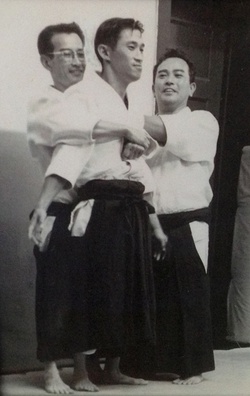
Monday, February 2, 2018. A not-unfamiliar scenario for me. Trudging through snow and temps in the teens on a Chicago winter night to teach aikido. Making my way to the well-worn green and red mats of Tohkon Judo Academy, based within the Japanese American Service Committee building, where my dojo (Chicago Aikido Club) has made its home for the past five years or so.

Will there be anyone there? I wonder. Does anyone ever come on nights like this, other than the poor soul designated to try impart a little knowledge (or at least provide a workout) on that given night?

Why do I do this?

It's crazy right?

At this point in my life - mid-forties, married, one kid - devoting any time to an interest as fringey as "the Art of Peace" (as aikido is sometimes popularly called by its followers) does sometimes seem a bit futile; maybe even irresponsible. After all - and with the deepest apologies to my teachers, seniors, fellow students, and the wider world of Japanese culture for what I am about to say - in one sense it is an act of dress-up: Grown men and women (and occasionally children) wearing faux samurai outfits practicing esoteric exercises that may or may not deserve the label of being a "martial art"; married to gestures, rituals and etiquette mimicking supposedly traditional rules from a country half a continent and an ocean away (And probably not that well, if I think about it).

It's even less a practical pursuit than my other passion - acting. At least with acting I get paid, though not always terribly well, since I'm still largely confined to Chicago's (highly acclaimed but) not very lucrative storefront scene (I did have an agent WHO-SHALL-NOT-BE-NAMED who used to get me film and TV auditions before unceremoniously dumping me via e-mail two week's before my son's birth. Fatter opportunities have kind of dried up since then.).

But here I am (or was, since now I am now comfortably sheltered from the cold within my north side apartment and a beer), prepared to do all the bowing, clapping, stretching, moving and calling-out-of-obscure-sounding-foreign-words that I have done since I (somewhat unwittingly) joined the Aikido club at Waseda University when I was an exchange student in the early 90s and found myself learning to toss people about or immobilize them against the ground.

Why do I do this?

A casual observer might think it's simply a matter of inertia. That strange force that sometimes keeps us in bad relationships and lousy jobs despite our better judgment. Like continuing to watch that long-running TV show you use to love despite the fact all the good actors have left and the storylines have become stale, repetitive and uninspired.

Insecurity? Ego? Certainly was true when I first started in Japan, where I discovered that my years of being an American couch potato reared on TV, snack foods and keeping my nose in books had ill-prepared me for the grueling physical regimen practiced by my Japanese college brethren. Not to mention the fact that despite looking the part, my Americanness (and perhaps I should add my half-Koreanness) were strikes against me. I was and am 99.99% sure they wanted me gone, and they worked me as hard as they could, but I absolutely, positively, assuredly refused to quit. First time in my life I had actually persevered in such a capacity, actually. And in the end, by the time I left to return to the states, I seemed to have gained a modicum of genuine respect (from myself as well as those around me).

Loyalty? A bit, I certainly don't like the idea of being a let-down to the senior instructors who've invested their teaching in me over the decades. Duty? I do feel some responsibility towards those junior to me that I give some of my time over to their learning and development (presuming they are maintaining their own interest and dedication).

But none of those really explain it all, or at least ring truest with how I feel, as opposed to how I think.

I continue to do aikido because it feels good. If I've had a long day working at my desk, chasing after my son, doing household chores, getting into uniform and stepping onto the mat never fails to make me feel better. Energized. Happier.

And it's not because I'm engaging in some cathartic act of sublimated violence. No, not that at all. Though, bodies hitting the floor is an unavoidable part of aikido practice. And I've been there - in the past, when I was younger, when I used the dojo as an outlet for daytime frustrations - at work, in relationships, unpleasant bozos on the street. No matter how much energy was expended, even if I got a bit of an adrenaline rush, whatever relief I felt was always a bit empty. Hollow.

Writing here, I find myself hesitating how to describe how aikido makes me feel good. Not because I'm afraid it will come across as hokey or unbelievable, or embarrassing for that matter. It's because it really does seem to defy easy description. I find myself thinking about Japanese writer Juichiro Tanizaki's seminal essay In Praise of Shadows, where he summed up Japanese aesthetics as an appreciation of subtlety and shadow, as opposed to Western ideas of light and clarity.

On that note, I find my thoughts have run out of steam. Will ponder and perhaps return to this later.



Tuesday, November 28, 2017

My Voicemail to the FCC 


"I am calling because of the apparent intent of the current management of the FCC to roll back Net Neutrality protections. I am a freelance Japanese document translator. I work almost entirely out of my own home, and have been able to make a successful living doing it. This would not be possible without fast, efficient and cost-effective access to the internet. I need it to both receive and send documents to my clients. I need it in order to process work orders, purchase orders and invoices, often done via my clients’ online portals. I need it in order to search the internet for reference documents and other materials that support my work. Some clients are even having me work via online platforms that require a safe and secure connection. Any changes in my current access will both make my work less efficient, and, if my fears are correct, eat into my profits. The FCC is currently under the umbrella of a Republican administration, which traditionally portrays itself as pro-business. I cannot fathom why it would undertake steps that would ultimately hurt small business owners such as me. Please reconsider your position, and do not roll back Net Neutrality in the interests of our society and economy. If not, please be assured that I will never consider voting for a Republican candidate, will never support the actions of any Republican administration, and will throw as much energy as I can against the current one."

Be sure to leave your own. Yes, it might not amount to much, but it is still better than nothing.
1-202-418-1000

Saturday, October 21, 2017


Promoting Peace with Urban Warriors
Reposted from the blog of Chicago Aikido Club (CAC).

(P.S. I'm leading these workshops)

----------------------------------------------------------------------

AAEAAQAAAAAAAA2KAAAAJGI1Y2Y0OTdkLTZmOGEtNDBkMS05MjdiLWRiODUwY2NiMTJmZQ

Chicago Aikido Club (CAC) will be partnering with Urban Warrior Fitness in Rogers Park to present two free Monday night introductory aikido workshops on October 30 and November 13. Both workshops will last 90 minutes and start at 7:00 pm.

The workshops will emphasize the use of aikido to develop mindfulness through movement, breathing and balance, as well the self-defense aspects of the art.

Both groups hope these workshops may be helpful to the local community, which is still dealing with the aftermath of a fatal shooting incident that took place on October 13.


Aikido Workshop at Urban

Monday, October 30 and November 13

7:00 pm - 8:30 pm

at Urban Warrior Fitness

1546 Howard St, Chicago, IL 60626

For more information, call (773) 754-7351, Ext. 0

Facebook event page

Monday, October 16, 2017

I don’t have a “Me too” to offer


I don’t have a “Me too” to offer. Thank God, I guess. But I do have a reflection. And that is I must regretfully admit that the collection of nerds, artists, martial arts enthusiasts, self-proclaimed intellectuals and liberals amongst whom I count myself and have many friends includes just as many abusers and gas-lighters as the jock bullies and bro-types commonly stereotyped as perpetrators. And though I have a few proud moments, such as when I ratted out a college dorm-mate engaged in an early form of cyber-bullying, or when I punched an actor backstage for making lascivious comments about an actress, there’s plenty of times I turned a blind eye and did nothing. Or I self-rationalized what I saw or heard. Or joined ‘the boys’ in locker room banter or lewd jokes over beers. And for that, and whatever other contribution I may have inadvertently or passively made to support the worst aspects of male American culture, I offer an apology. And I hope others do as well.

Sunday, October 15, 2017

“Night at the Nisei Lounge” (2013)

(reposted from the blog of Chicago Aikido Club)

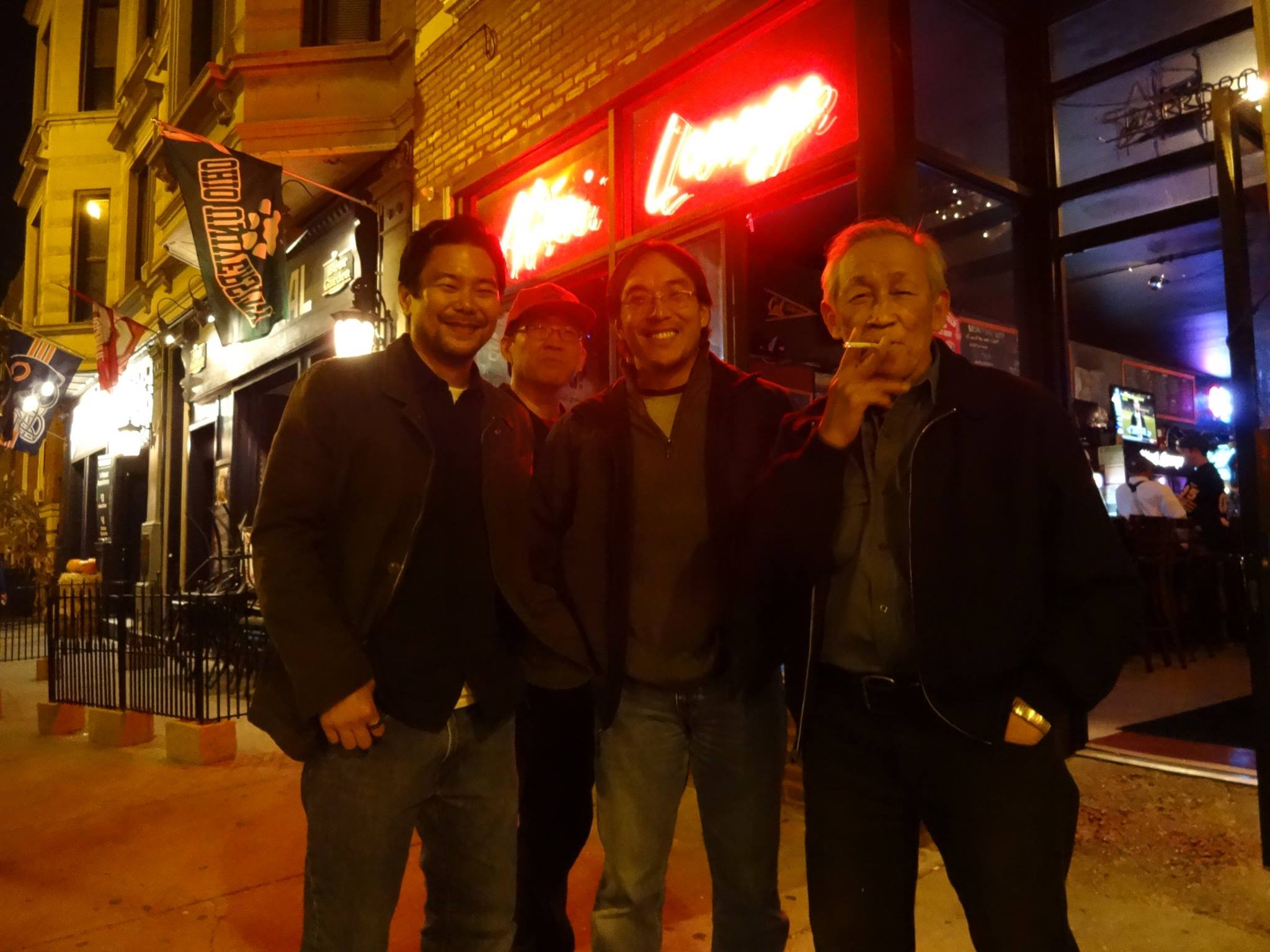
Erik Matsunaga, head instructor of Ravenswood Shorin-ryu Karate Dojo and who profiled Chicago Aikido Club (CAC) senior instructor Joe Takehara Sensei in Discover Nikkei recently shared this memorable photo and memory from 2013 with members of the two dojo getting together at a Japanese American community fundraiser at the Nisei Lounge bar in Wrigleyville.
22424635_10154825929386456_6833639026177328571_o
Left to Right: Ryan Yokota, Dean Yamada, Dwight Sora, Joe Takehara

Thursday, October 10, 2013

“Night at the Nisei Lounge” was a benefit fundraiser for the Japanese American Service Committee. Nisei Lounge is among the final vestiges of what used to be a sizeable Japanese American community that once resided in the shadows of Wrigley Field.

At one time, Takehara sensei lived on Newport Avenue, a half block east of the Nisei Lounge. He opened his dental practice one block south on Clark, across the street from Tony Muranaka’s home, whose matless, marble-floored basement served as the original gathering place for the Illinois Aikido Club. Incidentally, Detective Muranaka was the first Nisei on the Chicago Police Department.

After moving out of Muranaka's 3-flat basement, the IAC opened its first dedicated, storefront dojo with makeshift mats across the street from John Omori’s (co-founder of IAC) optometry practice.

And the Japanese American Service Committee, whose Uptown facility a mile-and-a-half up Clark Street currently hosts Takehara sensei and the Chicago Aikido Club, once triangulated these positions at its old location two blocks south of Nisei Lounge, on the corner of Sheffield and School.

I’d venture to guess Takehara sensei was the first Nisei his generation’s namesake tavern had seen in a long time, and quite possibly the only one since. For more information as to why that would be, peruse & listen to WBEZ’s recent Curious City feature: "What Happened to Chicago's Japanese Neighborhood?"

Thursday, August 17, 2017

The Goldfinger – Donald Trump Comparison


「Goldfinger images」の画像検索結果「Donald Trump images」の画像検索結果

1)         Both wealthy, aging, overweight men of German descent (with Anglicanized names)
2)         Both operate legitimate businesses (respectively jewelry/horse-breeding and real estate/brand licensing)
3)         Both engage in illegal businesses (respectively gold smuggling and Russian money laundering)
4)         Both collaborate with organized crime (respectively US and Russian mobsters)
5)         Both collude with foreign governments against the US (respectively China and Russia)
6)         Both surround themselves with beautiful women out of their league (and when no longer useful respectively have them killed and divorce them)
7)         Both have fat, creepy lackeys (respectively Oddjob  and Steve Bannon)
8)         Goldfinger employs Pussy (Galore), Trump grabs pussy
9)         Both like golf (and cheat)
10)     Both have access to nuclear weapons
11)     Both like gold

and


12) Goldfinger is defeated by a dedicated civil servant . . .

Tuesday, July 25, 2017

The history of the Trump administration told entirely through ABBA song titles


Money, Money, Money
Take A Chance On Me
The Name of the Game
The Winner Takes It All
Gimme! Gimme! Gimme!
Should I Laugh Or Cry
Under Attack
Slipping Through My Fingers
S.O.S.
When All Is Said And Done
The King Has Lost His Crown
.
.
.
Waterloo

Friday, February 3, 2017

May this Presidential Administration Die Hard with a Vengeance

Trump's supporters think he's this guy


I feel like Trump’s supporters think he’s like John McClane in the original Die Hard: A no-nonsense, tough-talking New York everyman who shoots straight and kills all those foreign terrorists who literally declare a ‘War on Christmas' and take a bunch of hard-working, all-American (largely white if I recall) corporate employees hostage in order to rob their company (which ironically, is a Japanese firm, if you remember) on the night of their holiday party. Despite their fancy tailored clothes, organizational savvy, high-tech gadgets, and eloquent, erudite continental mastermind leader Hans Gruber (Alan Rickman, chewy scenery with aplomb), McClane defeats them with sheer guts and determination, showing not just the bad guys who is boss, but all those pencil-necked, bureaucratic West Coast lawmen and bumbling feds who get in his way, as well as a useless media embodied by a craven, self-serving TV newsman.

But Trump is really this guy

Me, I think Trump is Harry Ellis. If you don’t remember, Ellis is one of the corporate hostages – a cocky, coked-up, snooty and obnoxious yuppie who blatantly hits on McClane’s wife Holly and goes out of his way to belittle McClane’s working-class status when they first meet. Later in the film Ellis decides to take matters into his own hands, telling Holly, “Hey babe, I negotiate million dollar deals for breakfast. I think I can handle this Eurotrash.” However, his ‘negotiation’ consists of blowing McClane’s true identity to Gruber and trying to get McClane to surrender (and likely be killed). It doesn’t work, and for his troubles Ellis doesn’t even make it to the end of the movie. Which is what I’m hoping for the current demented presidential administration.


Tuesday, January 31, 2017

Dear concerned parents of America: 

Buy books. Lots of them. Read to your kids. Take them to museums and libraries (for as long as we have them). Point to the sky at night and inspire them to wonder. Repeat to them names like Galileo, Einstein, Shakespeare, Chaucer, Newton, Twain, Steinbeck, etc. Introduce them to people of every age and color and encourage them to listen patiently to their stories. Arrange visits to churches, synagogues, mosques, temples, everything. If you weren't good at math, or science or history as a kid, don't hide it from your own children. Use this opportunity to study together. Take absolutely nothing for granted. Because we can't.

Tuesday, January 17, 2017

Lessons from Gandhi to use Today


Satyagraha - "insistence on truth" or “truth force.” The form of nonviolent resistance or civil resistance coined and developed by Mahatma Gandhi (1869–1948).

Code of discipline laid down by Gandhi for volunteers in the 1930 protests against the British colonial government

  1. Harbor no anger but suffer the anger of the opponent. Refuse to return the assaults of the opponent.
  2. Do not submit to any order given in anger, even though severe punishment is threatened for disobeying.
  3. Refrain from insults and swearing.
  4. Protect opponents from insult or attack, even at the risk of life.
  5. Do not resist arrest nor the attachment of property, unless holding property as a trustee.
  6. Refuse to surrender any property held in trust at the risk of life.
  7. If taken prisoner, behave in an exemplary manner.
  8. As a member of a satyagraha unit, obey the orders of the satyagraha leaders, and resign from the unit in the event of serious disagreement.
  9. Do not expect guarantees for maintenance of dependents.

Monday, January 9, 2017

Bear witness.
The federal week in review:
1. Trump fires all Ambassadors and Special Envoys, ordering them out by inauguration day.
2. House brings back the Holman rule allowing them to reduce an individual civil service, SES positions, or political appointee's salary to $1, effectively firing them by amendment to any piece of legislation. We now know why they wanted names and positions of people in Energy and State.
3. Senate schedules 6 simultaneous hearings on cabinet nominees and triple-books those hearings with Trump's first press conference in months and an ACA budget vote, effectively preventing any concentrated coverage or protest.
4. House GOP expressly forbids the Congressional Budget Office from reporting or tracking ANY costs related to the repeal of the ACA.
5. Trump continues to throw the intelligence community under the bus to protect Putin, despite the growing mountain of evidence that the Russians deliberately interfered in our election.
6. Trump breaks a central campaign promise to make Mexico pay for the wall by asking Congress (in other words, us, the taxpayers) to pay for it.
7. Trump threatens Toyota over a new plant that was never coming to the US nor will take jobs out of the US.
8. House passes the REINS act, giving them veto power over any rules enacted by any federal agency or department--for example, FDA or EPA bans a drug or pesticide, Congress can overrule based on lobbyists not science. Don't like that endangered species designation, Congress kills it.
We - progressive, liberal, libertarian and conservative - need to all wake up to what is actually happening to our beloved country.
#UnitedWeStand

COPY AND PASTE this entire post into your own status update instead of sharing. More of your friends will see it.

Monday, December 19, 2016


His face was cold. His mouth trembled, asking: "Who ­ who won the presidential election yesterday?"
The man behind the desk laughed. "You joking? You know very well. Deutscher, of course! Who else? Not that fool weakling Keith. We got an iron man now, a man with guts!"
.
.
.
There was a sound of thunder.

- Ray Bradbury, 'A Sound of Thunder' (1952)

Thursday, August 4, 2016


-Trump claims election process rigged if he loses.
-Comics fans claim Rotten Tomatoes illegitimate 'cause of bad reviews for new film.
-The film is called "Suicide Squad."
-Which aptly describes Trumps campaign.

Wednesday, August 3, 2016

Today in Awesome Korean Mom Hilarity

(My mom is babysitting my son Jack, who is resisting her attempts to clean him up post-lunch)

Mom: What are you doing? You're dirty Chinese, dirty Chinese!

(I give my mom a strange look)

Mom: Oh, in Korea, we call anyone dirty "Chinese."

Me: That sounds racist.

Mom: Yes, we are racist.

Monday, June 13, 2016

In the week that was, June 5 - 12, 2016 . . .

- We were reminded that committing rape doesn't mean the same if you're white, male and privileged. That a judge of similar background will show leniency in light of that person's "potential," and that potential will lead your parents to very publicly dismiss the gravity of your crime and its effects upon the victim (as well as the victim herself).

- That in the world of Chicago theater, despite its attitude of activism and action, its self-proclaimed striving for authenticity and the truth, can be home to 20 years of sexual harassment and abuse committed with impunity by an acclaimed and lauded artist, aided and abetted by silence, complacency and professional intimidation.

- That LGBT persons in America still have much to fear from others, simply for being themselves, simply for existing. That there's still way too many guns in the hands of the wrong people at the wrong times. That there's no political will to stop it. But there's way too much political will to dismiss the facts (like the fact the targets were LGBT) or to exploit the event (to inflame anti-Muslim, anti-Arab, anti-immigrant hysteria).

- That one of our two major political parties continues to be fronted by an ignorant, wealthy, racist demagogue spouting dangerous and inflammatory rhetoric

- That urban violence continues unabated.

- That the middle class continues to shrink.

- That the climate continues to change.

Just trying to get my head around the week that was.