Monday, May 23, 2016

Reposted from the blog of Chicago Aikido Club.

Stay Calm, Parents


On Monday, May 9 and Wednesday, May 11, Chicago Aikido Club (CAC) member Dwight Sora gave a short demonstration of aikido for the parents and children of the Tampopo Kai play group at the Japanese American Service Committee (JASC) of Chicago.


Invited by Tampopo Kai organizer Naomi Negi, Sora (whose 22-month-year old son Jack regularly attends Tampopo on Mondays) gave a short explanation of aikido's history and principles, and then demonstrated some basic techniques. He was partly aided in his demonstration by fellow parent Shimako Asakawa Walker (a former student of Tatsuo Toyoda Sensei at Tenshinkan Dojo), as well as some volunteers from the audience.
Aikido Pushing


Thursday, May 5, 2016

Aikido Instructor Relives the Past

This is a repost from the blog page of Chicago Aikido Club, the dojo where I have been teaching and practicing the Japanese martial art of aikido for the past four years. 


13082675_790837757725987_8506778664480973757_n
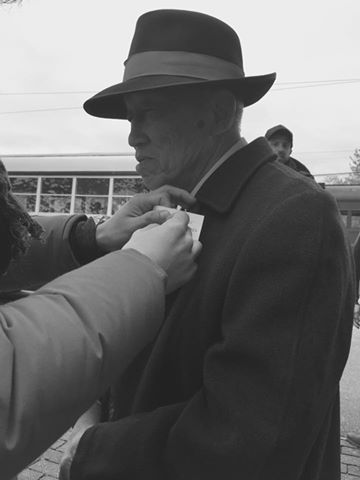
A member of the crew adjusts Joe Takehara's wardrobe
On Thursday, April 28, Chicago Aikido Club senior instructor Joe Takehara stepped back through time into his own past. Although the actual place was the Illinois Railway Museum in Union, Illinois, it had been dressed up with props and other items to recreate the moment when Japanese Americans were forced to leave their homes and board trains, eventually bound for "internment camps" set up in rural areas around the U.S. following the Japanese sneak attack on Pearl Harbor that kicked off the Pacific War and full-scale American involved in World War II. As a result of public wartime hysteria and racial intolerance, more than 110,000 Japanese Americans, nearly all who lived on the West Coast and including many American citizens, lost the homes and businesses they had spent lives building up, and would largely remain in the camps until 1944.
This was the set for The Orange Story, a short film in which Takehara plays a West Coast grocery store owner named Koji Oshima saying goodbye to his store before heading to the camps. The film is the first of four planned productions, and is being made in conjunction with an educational website for inclusion in curriculums at all levels of education.
The film is being produced by Chicago filmmaker Eugene Sun Park and his company Full Spectrum Features, in collaboration with fellow filmmaker Jason Matsumoto (a member of the Japanese drumming group Ho Etsu Taiko and is providing the soundtrack).
13095918_790837784392651_9043093634682563897_n
A shot is lined up on set
In real life, Takehara grew up in San Diego, California, and was relocated with his family to Poston War Relocation Center in southwestern Arizona. When the internment ended in 1945, his family migrated east, following a wave of some 20,000 Japanese American resettlers from various camps to Chicago (he was fourteen at the time).
The Orange Story is also being shot in California, and is slated to be released this year. It has been partially made possible by a nearly $160,000 grant from the National Park Service, which allocates funding for projects commemorating and preserving Japanese American confinement sites.
If you are interested in more information about The Orange Story project, please contact Jason at jason@fullspectrumfeatures.com or 773.504.4107.
UPDATE
An official fundraising campaign has been launched for The Orange Story. If you are interested in contributing, please visit the campaign website at http://tinyurl.com/zqujy3s.
Please include any of these links to your family and friends if they'd like to learn more:
Project Website: theorangestory.wordpress.com/
Facebook: facebook.com/theorangestory/
Inline image 1
Group photo from the railroad shoot


Wednesday, March 23, 2016

Giving Voice to the Past
Helping preserve the memory of Japanese American WWII veterans
Honolulu Chamber of Commerce Farewell Ceremony for Hawaii 442nd RCT soldiers, March 28, 1943

The contribution Japanese Americans made to the war effort during WWII is something that really deserves more mainstream attention. I'm not just saying this as a matter of ethnic pride, though that's certainly part of it (Two of my paternal grandmother's brothers - Haruo "Harry" Kono and Masuo "Mac" Kono - left Hawaii to serve in the 442nd).

Given that there was an undeniable racial dimension to the waging of the war, arguably even more so in the Pacific arena than in Europe (check out John W. Dower's excellent book War Without Mercy to get the full picture), the fact that there were American citizens who shared the names, faces and blood of an enemy of the U.S. yet still volunteered to fight against that enemy in the name of both patriotism and what was right is something that really needs to be hammered into the popular American consciousness. Particularly today, when, as of writing, the world is reeling from the Brussels terrorist attacks and cynical opportunists like presidential candidates Ted Cruz and Donald Trump have renewed calls for institutionalized discrimination and surveillance of Muslim Americans.

I realize those two gentlemen and their followers represent some of the least complicated thinkers on the planet, but that doesn't mean it isn't important for the rest of us to repeat, reiterate and re-teach the complicated reality that there is no simple, one-to-one correspondence between a particular race or religion and the capacity to do harm to our country. And to add, that there are always people many Americans don't think of as true countrymen who would lay down their lives to protect these shores.

In my dreams, there would be a plethora of mass media works chronicling the story of the 442nd Infantry Regiment, the 100th Infantry Battalion, the Japanese American Military Intelligence Service (MIS) and others, ranging from big-budget Hollywood epics along the lines of Glory and miniseries like Band of Brothers to heavily promoted Ken Burns-style PBS documentaries (or even a Making a Murderer like series on Netflix). Right now, unfortunately, that isn't the case, and based on the recent #OscarsSoWhite controversy, I'm not holding my breath until they get made.

Until that time, however, there's still some good news on the horizon. The Go For Broke National Education Center* in Los Angeles is opening a new exhibition in Little Tokyo on May 28, 2016. Titled Defining Courage, it will include interactive audio and video exhibits based on years of recording the oral histories of Japanese American veterans.

Artist rendering of the Defining Courage exhibition

I first found out about the exhibition was I was put in touch with the folks at Quatrefoil, the company working with the Go For Broke National Education Center to put everything together. Quatrefoil was looking for people to make audio recordings based on transcribed interviews. Bob Kumaki, who is active in the local Chicago Japanese American community, knew I had worked as an actor, and gave me their contact info.

Ultimately, I ended up making about a dozen or so recordings, telling the stories of Japanese American WWII vets in their own words. Some were from the mainland, while more than a few were from Hawaii (for which I had to try out my best imitation pidgin accent). Exactly how many will end up part of the final product is unknown, but Quatrefoil kindly provided me with a handful of final edits and said it was okay to share them here.

This project was definitely a joy to work on, and I'm grateful to the folks at Quatrefoil and the center for bringing me aboard, even if by long-distance (I made the recordings in my apartment in Chicago and e-mailed to LA). I can't make the grand opening on May 28, but I encourage as many people as possible to attend. And keep your ears open, you may hear a familiar voice.

Cedrick Shimo

Gene Akutsu

George Oiye

Kiyoshi Bones Fujimoto

Minoru Tsubota

Tets Asato


Wednesday, March 2, 2016

Welcome to Pleasure Town

Mini9 - Bad Water

Here's something new. A couple of months back, an acting colleague put me in touch with the makers of the audio drama podcast Pleasure Town. They were looking for an Asian American actor to play a Chinese character in an upcoming minisode. I wasn't familiar with their work before, but now discovering it, it's a neat little ongoing project.

As described on their website, "PleasureTown is a story-based podcast told in serial form that details the history of a little-known, failed Oklahoma utopian society. The town’s history is crowdsourced, piece by piece, by the producers, collaborators and audience members." The whole thing is part of the WBEZ Podcast Network, which is also the home of the acclaimed true-crime series Serial.

So, check it out if you're interested in a little trip back through time to the old frontier. 

This also reminds me, I'm overdue on checking out my buddy Soren Fanning's Mischief and Mayhem podcast. If you're searching for some good, alternative political and historical discussion, considering making a visit.


Monday, February 1, 2016

WTF . . . 


「public urinal image」の画像検索結果


Odd WTF moment over the weekend that's been bugging me. Was down at Navy Pier and while in the stall at the public restroom, I overhear these two guys talking. One says, "Dude, Asians are always peeking over the urinal to take a look at how big I am. I've caught at least two of them doing it." I come out and there's these two young white guys standing by the sinks, who get real quiet as I come around the corner with a nasty look on my face. Is this really the sort of conversation that goes on when (it is thought) someone like me isn't in the room?

Monday, November 23, 2015

Cool Stuff in Aikido: Techniques and Peace

I was recently sent a flyer from some old friends at Thousand Waves Martial Arts & Self Defense Center. My dojo, Chicago Aikido Club (CAC), did an intro demo and workshop there some time back. This time around they will be hosting an instructor I've long admired, Jamie Zimron on Saturday, December 5. Hopefully I can make it. 


Wednesday, November 18, 2015

Looking forward to driving Arab cars

No, this is not an Arab car. It's the Toyopet. But read on.

I am really looking forward to the day that I can drive an Arab car. Or maybe a Muslim car, if there is such a thing.

Not literally, I mean, I don't really know anything about the state of the auto industry in the Middle East. I'm completely ignorant to that aspect of their local economies.

What I mean is, in light of the Paris attacks last week; the return of 9/11-level anti-Arab/anti-Muslim/anti-anything-that-resembles-an-Arab-Muslim rhetoric spewing from the vacuum-brained and toxic-mouthed pit of Fox News and the current crop of Republican presidential hopefuls, plus the attempts to outdo each other in Ebenezer Scrooge-levels of non-sympathy regarding Syrian refugees being paraded across Facebook from conservative-leaning friends and relations (God bless you all, insofar as you are still members of the human race . . . genetically anyway), I've now decided that the best way to stave off the indignant rage-induced headache creeping up my spine is to look towards the future.

And that is a future in which we are driving Arab cars.

Think of it this way. Back during that little skirmish known variously as World War II or the Pacific War or the Second Sino-Japan War, the then-Empire of Japan was engaged in what truly was an existential conflict with the West and its Asian neighbors between 1937 and 1945. According to Professor Rudolph Rummel, the civilian death toll alone was 5,424,000.

In the United States, it'd be safe to safe that a pretty sizeable dollop of the national stockpile of hatred was reserved for Japan, especially after the December 7, 1941 surprise attack on Pearl Harbor. Admiral William "Bull" Halsey, the legendary American naval commander, certainly didn't mince his words.  “Kill Japs, Kill Japs, Kill More Japs!” he told his troops. “The more of the little yellow bastards you kill, the quicker we go home!” And he certainly wasn't one for half-measures, no siree. “Before we’re through with ‘em, the Japanese language will be spoken only in hell.” he extolled. He, and a lot of his fellow Americans, were not interested in mere military or political defeat. He was talking extermination.

And that hatred was so virulent, so extreme and so blinding, the U.S. government ordered the rounding up and imprisonment of over 127,000 Japanese American men, women and children because of their unfortunate geographical and ethnic connection to the nation's enemy. An "internment" they called it; a "relocation," in which homes, businesses, fortunes, lives these people had built up over decades were shattered, along with any semblance that the flag, the constitution or any of the promised freedoms in this country mattered.

(And by the way, as of writing, the news is circulating about that the Mayor of Roanoke, Virginia, David A. Bowers, in an act of mind-boggling galactic stupidity, has invoked the internment as grounds for rejecting the taking in of Syrian refugees).

But I digress; back to cars! Anyway, after the war ended, an ending in which the Allies were victorious and Japan was in ruins, followed years of U.S. military occupation, reconstruction, the 1964 Tokyo Olympics, the Showa era Godzilla films, and Mach Go Go Go on TV (that's Speed Racer for the rest of you), and then something happened: The Japanese car!

Seemingly out of the blue (though not for anyone paying attention), Japan's automakers (You know the names - Toyota, Honda, Nissan, etc.) broke onto the scene and by the 1980s overtook the U.S. as the world's leading car producer.

And not just that, suddenly, Japanese stuff was cool and hip and trendy. Back in the 1940s, U.S. propaganda films mocked Japan's traditional rice-based diet; the idea of eating raw fish was considered barbaric. Sure, some things were acceptably exotic, like purchasing paper parasols or picking up Japanese bar maids if you were a soldier during the occupation (just don't bring her back home to mother).

Now, sushi restaurants were springing up left and right, American businessmen were reading copies of the classical samurai strategy guide The Book of Five Rings to gain insight into their overseas competitors, little kids were taking karate and judo at the YMCA (uniforms to be repurposed into Luke Skywaker costumes at Halloween), and the television event of 1980 was NBC's mini-series adaptation of James Clavell's novel Shogun.

And it has never stopped. Japanese stuff was (is) here to stay. Anime, sudoku, Pokemon, tamagochi, Mighty Morphin Power Rangers, Naruto, Ruronin Kenshin, Nintendo, Sony XBOX, ramen . . . the list goes on and on.

So what's my point? With all the loud-mouthed bile being shouted about Arabs and Muslims, with all the naked hate being propagated about the internet accusing every non-Jewish Semitic person of being a wide-eyed, suicide-bombing terrorist mongrel, I dream of a future where all of that is behind us. Where it is more than forgotten, it's been pushed aside by something different; a positive and possibly hipster embrace of all things Arab and Middle Eastern.

I'm imagining a reality with Arab restaurants of every size and shape dotting both metropolitan landscapes and far-off suburbs. A world where white college guys are studying up on Arabic in a desperate attempt to ask the cool Iraqi girl in class on a date. I see food trucks dispensing grilled halloumi, and dance clubs cranking out a fusion of hiphop and Berber or Moroccan melodies.

Sure, things won't be perfect. But wouldn't it be great if the only notes of overt hatred were past-tense reminisces of that old Arab/Muslim-hating relative?; "Yeah, my granddad use to say 'raghead' all the time, and now I drive an Arab car."

What if the only problems being faced were whether the right actor was being cast as that popular Arab or Muslim comic book superhero or whether that new Arab-themed Broadway musical was culturally authentic enough? That would be a giant Neil Armstrong-sized footstep in the right direction, if you ask me. Certainly a better direction than the antagonistic indifference and ignorance we see being bandied about online and on the airwaves.

And yeah, this is a reality I really, really, really want to happen. One because I can't stand what I'm seeing and hearing in the media, but also because of some personal encounters with the legacy of hatred.

Now, I've never been a refugee myself, nor had first-hand encounters with the terrors of war (thank God). But, as I'm half-Japanese and half-Korean, I've had a handful of unfortunate run-ins.

One that I remember is my first trip to South Korea. On Christmas Eve, my grandmother took me to the Methodist church in Seoul that my great-grandfather had founded as its minister. The current junior minister was introduced to me by my grandmother (he spoke English) and we had the following exchange.

Minister: "So, I understand you don't speak Korean."

Me: "No, I don't."

Minister: "But you do speak Japanese?"

Me: "Yes."

Minister: "And you are studying in Japan?"

Me: "Yes." (I was an exchange student to Waseda University at the time)

And at that point, the minister looked at me very seriously and sternly and said:
"I think the Japanese are the worst people in the world."

I had no reaction. And he continued.

Minister: "You see that girl over there."

I looked and nodded.

Minister: "That is my daughter. I tell her every day that the Japanese are the worst people in the world."

And with that he ended. Merry Christmas.


So, after that long-winded explanation, that's why I want to say, I dream of a day when we can be driving Arab cars.